
Glimpses: Meeting Mother Teresa
Encounter with a Saint
Calcutta, India, 1987 · Part 2 of 2
“Oh, it’s you again.”
So I was to be Mother Teresa's guest at the renowned Dying & Destitutes! Amazing. After Mother departed, I waited about half an hour by the door for all the sisters. I was getting a little concerned, as I had a flight to Varanasi later in the evening.
Then a whole group of sisters came out to greet me. I counted 16. It was three o’clock; their three-hour prayers had ended and now they were set to work the remainder of the day. I felt a little guilty that so many were escorting me, but I figured they were part of the afternoon shift.
Wouldn’t you know. The sister-in-charge of our group was the very sister at the door on my first visit, and the same one who let me in today as a favor. When seeing me, her face seemed to say “Oh, it’s you again”, but she was pleasant. The sister that Mother had asked to arrange this outing came over and took me under her wing.
Our entourage walked to the bus stop and waited. People greeted the sisters with reverence. When the bus arrived, all the sisters and I boarded the bus. The sister-in-charge took a folded ten-rupee bill out of a little tin and handed the precious funds to the bus driver. They were adamant that I not contribute.
The buses in Calcutta are incredibly crowded, noisy and dirty. You have all types of people getting pushed and shoved together as the driver speeds down the roads, swerving from side to side to avoid the traffic and potholes. It was quite a chaotic ride with these dear sisters. We were all standing, holding firmly onto the rail above to keep from falling, while everyone in the bus studied our every move. I was honored to be with them. It was clear they were respected by the locals; one uniformed schoolboy even offered me his seat because of them.
The bus ride was long, but we got there in one piece. We arrived at Kalighat, Home of the Dying & Destitutes. Walking up to the entrance was an extraordinary scene of squalor and disease. When you are so ill and out of hope this seems to be the place you go and try to gain entry. It was sobering. These desperate people seemed to be especially reaching out to me as we walked by, perhaps because the sisters’ presence was already known.
Mother established this as a sanctuary where terminally diseased people, often abandoned on the streets, can go to die with dignity. To “have a beautiful death”, as Mother would say. Her mission actively goes out to find street people who are dying and bring them here to rest. All marginalized people, regardless of caste, regardless of faith or lack thereof. There are people with tuberculosis and leprosy, open wounds and gangrene, and severe malnutrition and deformities from a life of poverty. It is a place of extreme suffering.
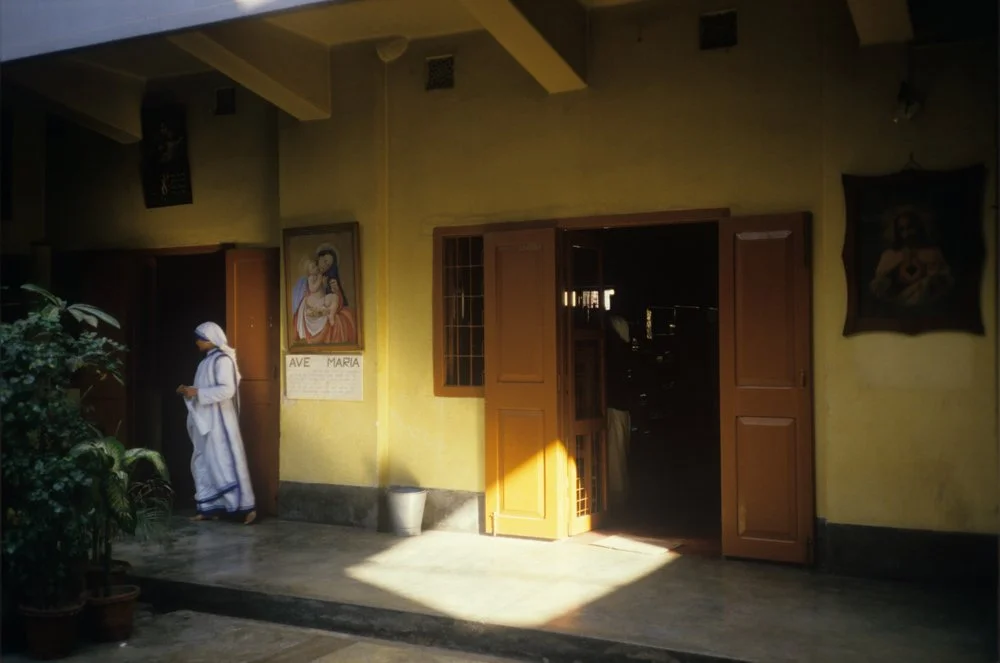
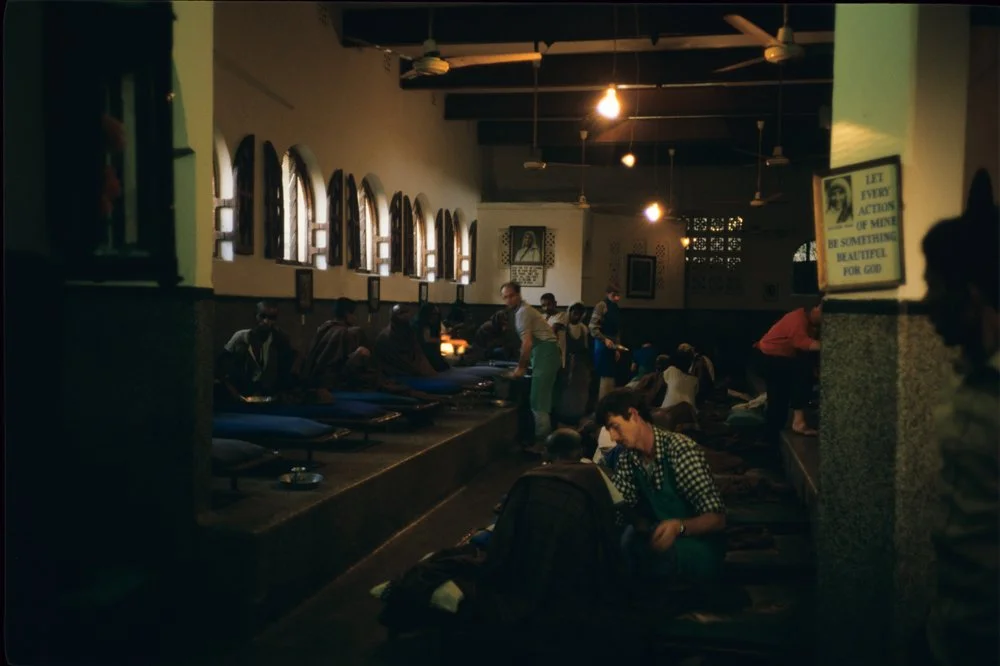
The building was large, painted in yellow and aged in dirt. It was a former Hindu temple adorned with Mughal domes, so an Indo-Islamic fusion. Not what I expected, but arresting. As you entered, there was a big open-air room with tile floors and cement walls and over a hundred cots low to the ground where diseased people lay. They looked afflicted and distressed. There were Bible verses and pictures of Jesus on the walls. And a sign at the entrance: “The greatest aim of human life is to die at peace with God.” Visually the scene was moving.
But so incredibly incongruous. Not only did I not hear a celestial choir singing as the heavens opened up, as hoped before with Mother – I heard extremely loud, raucous heavy metal rock music blaring from above. The harsh sounds were so jolting and disconcerting and the opposite of what my eyes were witnessing. I was told a family upstairs was playing it, and to ignore it; the volunteers seemed to be attending to the needs of the dying and doing just that. I took their cue.
The volunteers come from around the world to help the sisters. I was introduced to a young man from New Zealand, James, who was consoling people. His role was to care for these dying people through cleaning, feeding and comforting. I could see it was an emotionally draining job. He showed me there was a separate male and female ward, each having rows of cots with numbers painted on the walls above. Each cot had a plastic sheet under it. People are assigned to a cot, are mostly lying down wrapped in blankets, and many are sleeping.
At a distance, you don’t get a true sense of how dire things are. Part of it is that you've seen these types of people on the street before. When you get closer, though, you see that these poor souls are literally in the final stages of death. Many are suffering from tuberculosis, coughing and gasping for air, many have huge open sores and disturbing deformities, and all of them are incredibly skinny, so frail, nearly all bones. There were men and women crunched up in blankets, some looking up to me and extending their hands. They needed a human touch.
James said that they don’t preach to these people. There’s really no religious instruction. They just demonstrate God’s love in a very practical way. They show that God is real. One of the signs said “Let every action of mine be something beautiful for God.”
It was mealtime. We took these great big silver pails, one with rice, and one with curry. We had tins to scoop out food from both, put in a person’s bowl and set it on the bed. Many of them grabbed and ate it with their hands right away. Some of them waited and didn't seem excited; they were probably too sick. There was this one perky guy who enjoyed the food. He gave me the thumbs up. We smiled big at each other. I felt a real connection. It felt good, and I hope he was uplifted as well.
The saddest thing was the makeshift morgue in the back. It was used almost daily. There’s a sign that says, “I'm on my way to heaven.” There were two people who recently died, both women, wrapped in white sheets, with their heads exposed. They were so small and frail, lying side by side with matted hair. I had never been so close to death before. Never seen it, smelled it, felt it. I reflected on what kind of life these women likely had. I hoped that they were truly on their way to heaven.
I realized the heavy metal music was gone. I had been so absorbed in my encounters that I tuned out and didn’t recall exactly when it stopped.
I had a last conversation with James. Volunteering had been a rich experience for him. He learned how transformative practical love and service can be. He had seen so many die with dignity. He came with grand expectations but found that the sisters are human as well. They don't just smile and sing. They are real people who can get frustrated and short and yet work hard to do their best. A real-world display of love.
I said goodbye to my dear sisters. I thanked them deeply for the honor. I had been there for several hours, and would have loved to stay longer, but had to catch my flight.
As I walked outside, I met the most aggressive begging I was to experience in India. Desperate, diseased people came rushing up to me. They started grabbing and touching me. They were yelling out. There were little kids with big scabs on their head and a man with an awful, damaged eye. It was upsetting and my thoughts were to run.
But I didn’t have to. An older Indian man shouted something in Bengali. They all scattered. I was relieved but also conflicted. It made my Dying Destitutes experience even more moving, because it underscored what an impossible situation so many are in. These were likely the destitutes that, for some reason, have yet to gain entry.
The events of this day had been surreal. It means even more now that I've had time to reflect.
I did indeed have a holy experience. My expectation for choirs and heavens was naive. The world needs more tangible demonstrations of love like this. More love of your neighbor in a real way. The world needs more Mother Teresas. She was strong and resilient, navigating a rough and raw and hurting world, and shared God’s boundless love through doing. She was, in truth, a saint.
Postscript
A year later, a LIFE magazine photographer was granted access and published a photo-essay on the Home of the Dying & Destitutes. It was so uplifting to see his experiences of Mother and her work were so in line with mine.
A few years later, Princess Diana, emulating what Mother Teresa did with leprosy, touched an AIDS patient while in New York. They later joined forces. Princess Diana, with all her fame, was just as influenced by Mother as I was.
I read more about Mother along the way. Her journey had its own twists and turns, from Albania to India. She didn't grow up wanting to become famous. She didn’t always see where she was going or understand what was happening. She had doubts. Yet she followed, and God took her to where she belonged.
“Let every action of mine be something beautiful for God.”
— MOTHER TERESA